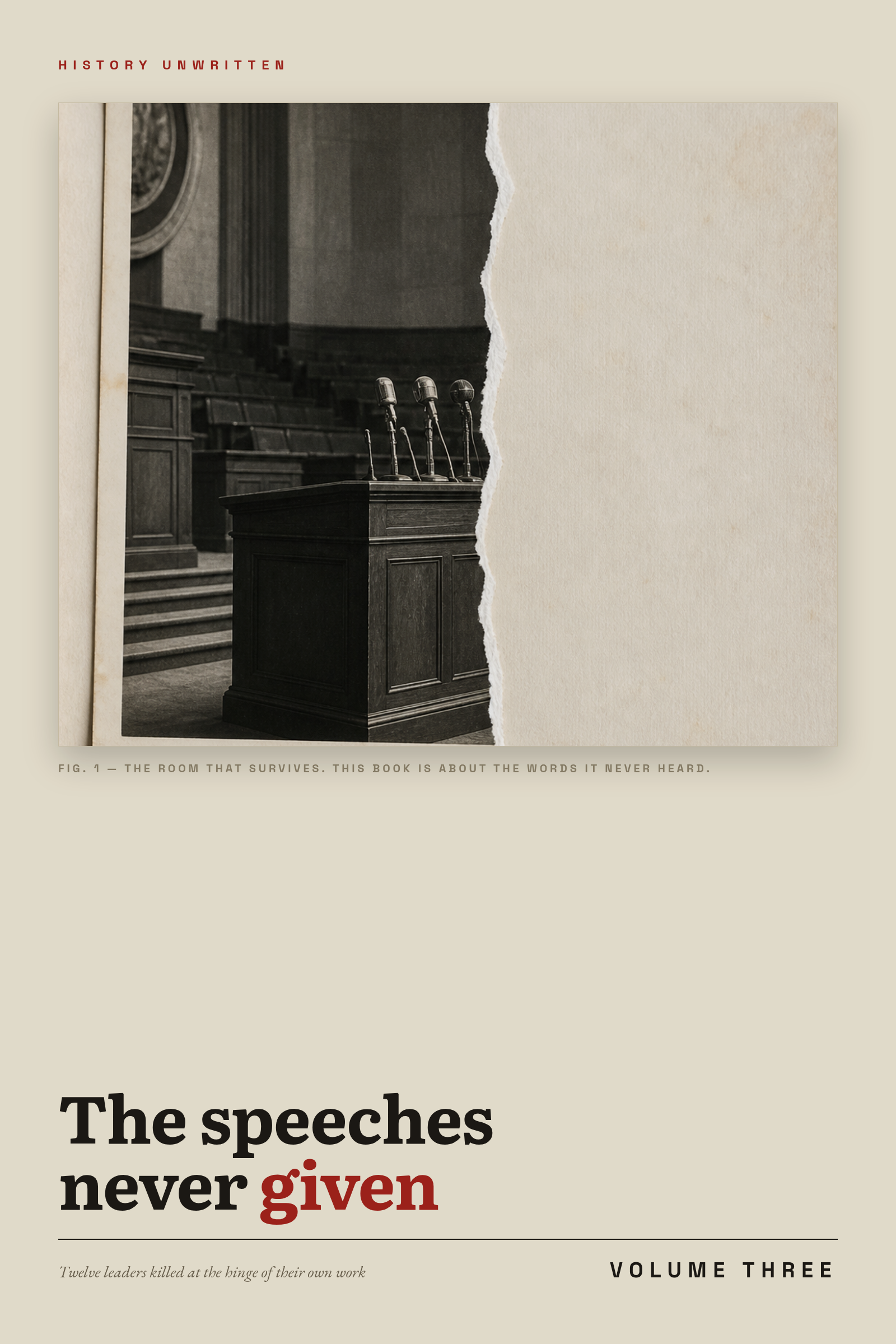
Case files · what the record shows · and where it ends
The companion ebook to the History Unwritten channel
Twelve songs the world never heard
A plane that should have stayed on the ground. A dose stronger than the last one. A diagnosis four years too early. Twelve musicians who died in the middle of the work, and the records, the tours and the decades that went with them.
MethodEvery chapter starts with the documented record — the room, the hour, the medical report — and only then follows the thread history cut. Where the record ends, the book says so.
Total price. No VAT is charged (small-business scheme, § 19 UStG).
Secure payment via Stripe. Download link immediately after purchase.
Length196 pages12 chapters, about 51,000 words
FormatsPDF + EPUBBoth included in one payment
DeliveryInstantDownload link on screen after payment
AccountNoneNo subscription, no login, yours to keep
Exhibit 1
What this book is
Not a collection of fantasies. Every chapter starts with what verifiably happened — the room,
the hour, the medical report, the police file — and only then follows the thread that history
cut. Where the record ends, the book says so.
The real ending first
Each life gets its documented final hours before any speculation begins. You cannot feel the loss of a future you were never shown.
One honest turning point
No magic, no time travel. One plausible change — a different route, a faster ambulance, a cancelled appearance — and everything that follows from it.
The world that arrives instead
Decade by decade: the records never made, the elections never held, the movements that kept their leader. Consequences, not wishes.
Index
The twelve musicians
Each chapter stands alone. Open a file to see who it is about and which single
change the chapter follows — no ending is given away here.
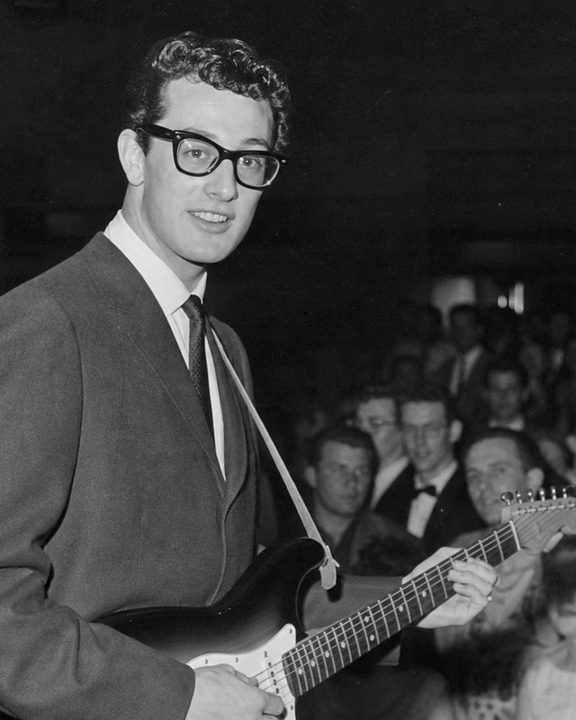
01Buddy HollyFebruary 1959, a frozen airfield in Iowa. A broken bus heater, and a flight that never had to happen.1959
Buddy Holly, 1959 · AI-generated illustration
What the record shows
February 1959, a frozen airfield in Iowa. A broken bus heater, and a flight that never had to happen.
The turning point this chapter follows
The Beechcraft stays on the ground at Clear Lake, and the twenty-two-year-old who had just started writing for strings lives to hear what the Beatles did with his chord shapes.
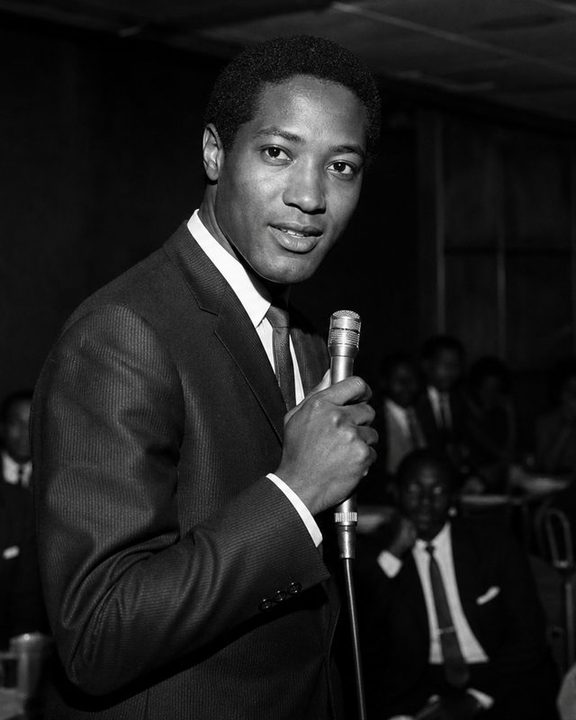
02Sam CookeDecember 1964, a motel office in Los Angeles. The song he wrote for a decade he never saw.1964
Sam Cooke, 1964 · AI-generated illustration
What the record shows
December 1964, a motel office in Los Angeles. The song he wrote for a decade he never saw.
The turning point this chapter follows
The manager at the Hacienda Motel does not reach for the pistol, and the man who wrote 'A Change Is Gonna Come' is alive to sing it into the years it was written for.
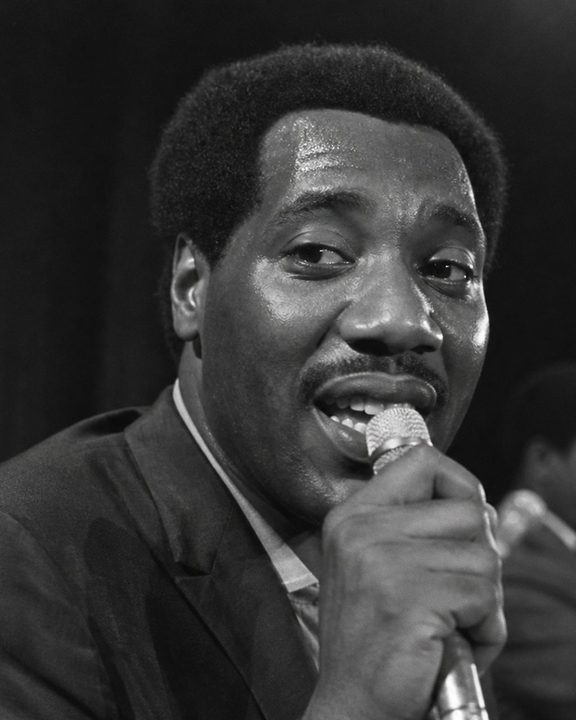
03Otis ReddingDecember 1967, fog over a Wisconsin lake. Three days after the best record of his life.1967
Otis Redding, 1967 · AI-generated illustration
What the record shows
December 1967, fog over a Wisconsin lake. Three days after the best record of his life.
The turning point this chapter follows
The twin Beechcraft clears the fog over Lake Monona, and the man who had recorded 'Dock of the Bay' three days earlier gets to hear it played on the radio.
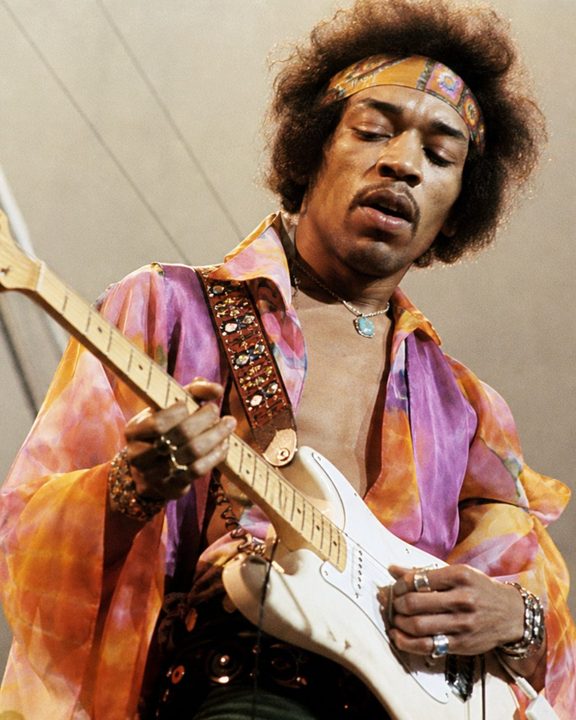
04Jimi HendrixSeptember 1970, a flat in Notting Hill. Four weeks after he opened his own studio.1970
Jimi Hendrix, 1970 · AI-generated illustration
What the record shows
September 1970, a flat in Notting Hill. Four weeks after he opened his own studio.
The turning point this chapter follows
The nine Vesparax tablets stay in the packet in a Notting Hill flat, and the guitarist who had just built his own studio finds out where he was going next.
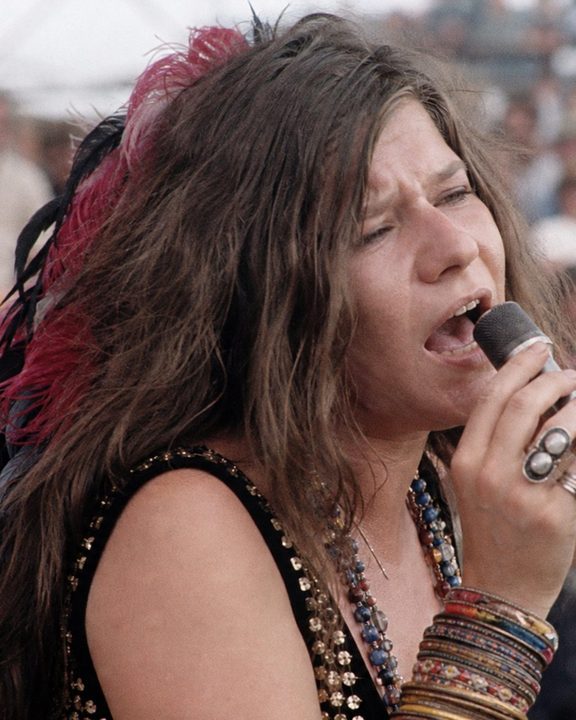
05Janis JoplinOctober 1970, a Hollywood motel. A batch stronger than the last, and an album two weeks from done.1970
Janis Joplin, 1970 · AI-generated illustration
What the record shows
October 1970, a Hollywood motel. A batch stronger than the last, and an album two weeks from done.
The turning point this chapter follows
The heroin that reaches the Landmark Motor Hotel is the usual strength, and the woman two weeks from finishing her best record finishes it herself.
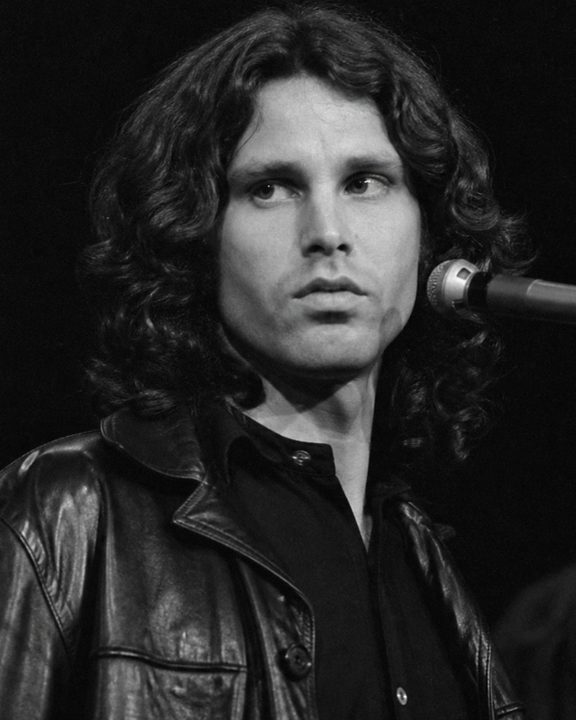
06Jim MorrisonJuly 1971, an apartment in Paris. A rock singer who had quit to be a poet.1971
Jim Morrison, 1971 · AI-generated illustration
What the record shows
July 1971, an apartment in Paris. A rock singer who had quit to be a poet.
The turning point this chapter follows
The heart in the bathtub on the rue Beautreillis keeps going, and the man who had left rock to be a poet in Paris has to decide whether he meant it.
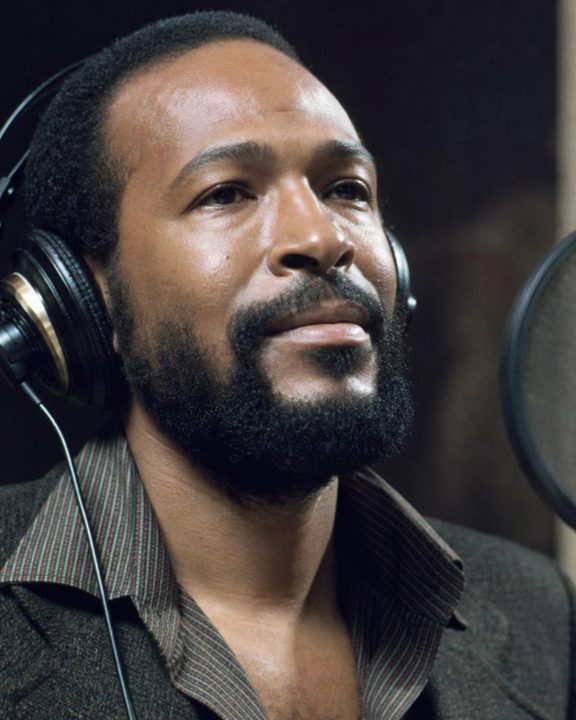
07Marvin GayeApril 1984, his parents' house in Los Angeles. One day before forty-five, two years after the comeback.1984
Marvin Gaye, 1984 · AI-generated illustration
What the record shows
April 1984, his parents' house in Los Angeles. One day before forty-five, two years after the comeback.
The turning point this chapter follows
The argument in the house on Gramercy Place stays an argument, and the man who had just come back from three lost years turns forty-five the next morning.
08Freddie MercuryNovember 1991, Kensington. Four years short of the medicine that would have worked.1991
Freddie Mercury, 1991 — the setting, not the person · AI-generated illustration
What the record shows
November 1991, Kensington. Four years short of the medicine that would have worked.
The turning point this chapter follows
The pneumonia in November 1991 is survivable, and the singer holds on four more years to the drugs that arrive in 1996.
09SelenaMarch 1995, a motel room in Corpus Christi. The crossover album was already recorded.1995
Selena, 1995 · AI-generated illustration
What the record shows
March 1995, a motel room in Corpus Christi. The crossover album was already recorded.
The turning point this chapter follows
The registered handgun in the Corpus Christi motel room stays in the handbag, and the crossover album she had already recorded comes out with her alive to tour it.
10The Notorious B.I.G.March 1997, a red light in Los Angeles. Sixteen days before the record that made him.1997
The Notorious B.I.G., 1997 · AI-generated illustration
What the record shows
March 1997, a red light in Los Angeles. Sixteen days before the record that made him.
The turning point this chapter follows
The GMC Suburban pulls away from the Petersen Museum before the dark Impala draws level, and the album called Life After Death comes out with its author still here.
11Michael JacksonJune 2009, a rented house in Holmby Hills. Fifty sold-out nights waiting in London.2009
Michael Jackson, 2009 · AI-generated illustration
What the record shows
June 2009, a rented house in Holmby Hills. Fifty sold-out nights waiting in London.
The turning point this chapter follows
The propofol drip in the house on North Carolwood Drive is never set up, and the fifty sold-out nights at the O2 actually happen.
12Amy WinehouseJuly 2011, a bedroom in Camden. Weeks sober, with a third album already being written.2011
Amy Winehouse, 2011 · AI-generated illustration
What the record shows
July 2011, a bedroom in Camden. Weeks sober, with a third album already being written.
The turning point this chapter follows
The three empty vodka bottles in the Camden bedroom are never opened, and the singer who had been sober for weeks gets to make the third record.
— or open them in order
From chapter one · Buddy Holly, 1959
The Surf Ballroom in Clear Lake, Iowa, held its last note a little after midnight on February 2, 1959. Buddy Holly had played two sets with a pickup band, backing singers Dion and the Belmonts, Ritchie Valens, and J.P. Richardson, known onstage as the Big Bopper.
The Plane That Did Not Take Off
Read the opening of chapter one here
Buddy Holly, 1959 — The Plane That Did Not Take Off
The Surf Ballroom in Clear Lake, Iowa, held its last note a little after midnight on February 2, 1959. Buddy Holly had played two sets with a pickup band, backing singers Dion and the Belmonts, Ritchie Valens, and J.P. Richardson, known onstage as the Big Bopper. The tour was called the Winter Dance Party, twenty four one night stands across the frozen upper Midwest in twenty three days, booked by an agency that gave almost no thought to the distances between towns, the condition of the bus, or the fact that a Midwest February routinely drops well below zero at night.
The bus itself had already failed once. Its heater had broken days earlier, and the drummer, Carl Bunch, had been hospitalized in Ironwood, Michigan, with frostbite in his feet, bad enough that he could not go on. Holly had been playing dates with a borrowed rhythm section and sleeping, when he slept at all, in a coat on a bus seat with newspaper stuffed against the windows. He had had enough of it. Sometime that afternoon or evening he asked about chartering a plane to get himself, and whoever wanted to come, ahead to the next stop, Moorhead, Minnesota, so there would be time to do laundry and rest before the following night's show. The airfield that could take the charter was not in Moorhead itself but across the river in Fargo, North Dakota, at Hector Airport, close enough to serve the same date.
Hubert Dwyer, who ran a small flying service out of Mason City Municipal Airport, took the charter. The airplane was a Beechcraft Bonanza, tail number N3794N, a four seat single engine machine, and the pilot was Roger Peterson, twenty one years old, a local flight instructor with several hundred hours logged, mostly by sight rather than by instruments. Peterson held a private pilot's certificate and was working toward an instrument rating, but he had already failed one attempt at the checkride for it and had not yet passed a second. That distinction mattered more than anyone at the airport that night seems to have weighed.
There were three seats besides the pilot's. Holly took one. Waylon Jennings, playing bass in Holly's band that winter, had a seat and gave it up, at Richardson's request, because Richardson had a bad cold and the unheated bus was punishing him. Tommy Allsup, the guitarist, had the third seat and lost it to Ritchie Valens on a coin toss backstage. Jennings has said in interviews across the following decades that as he handed his seat over, Holly told him, in the joking register of two men who had spent three weeks freezing together, that he hoped the bus froze up again, and Jennings answered that he hoped the plane crashed. Jennings carried that exchange for the rest of his life.
The chapter runs on for another twenty pages: the hours after, the
people in the room, and then the turning point.
Download the full first chapter as a PDF — or
.
Statements
What readers say
Only verified buyers can leave a review, directly from their download page.
Nothing here is written by us.
Queries
Before you buy
What exactly do I get?
One payment, two files: a PDF for reading anywhere and an EPUB for Kindle, Tolino, Kobo and Apple Books. The download link appears on screen straight after payment and is sent to your e-mail as well. The files are yours; there is no account and nothing expires.
Is this just the YouTube scripts?
No. The chapters are written as text, and they go further than an episode can: the documented record in full, the people around the turning point by name, and the decades that follow it. If you have watched every video, the book is still the longer version.
Are the alternative histories presented as fact?
Never. Each chapter marks exactly where the record ends and the reasoning begins, and it says plainly that nobody — this book included — knows what would really have happened.
Where do the portraits come from?
They are AI-generated illustrations, and every one of them is labelled as such under the image. They show the person at work, in the period the chapter is set in. They are not photographs and are not presented as evidence — the evidence is in the text.
Can I get my money back?
Digital content is delivered immediately, and at checkout you expressly agree to that, which ends the 14-day right of withdrawal (§ 356 (5) BGB). If a file will not open or a download fails, write to us and you get a working file or your money back — that is a service promise, not a legal one.
How is payment handled?
Stripe processes the payment; we never see your card details. Total price, no VAT is charged (small-business scheme, § 19 UStG).
Acquire
Get the ebook
One payment, no subscription, no account. You receive a download link straight after payment.
PDF for reading anywhere, EPUB for Kindle, Tolino and other e-readers. Both formats are
included; 196 pages, 12 chapters, about 51,000 words.
−50%19.989.99 EUR
The price runs on a fixed rhythm: seven days reduced, one day at the regular price, and the clock above shows where in that rhythm you are. No fake scarcity — the same cycle repeats.